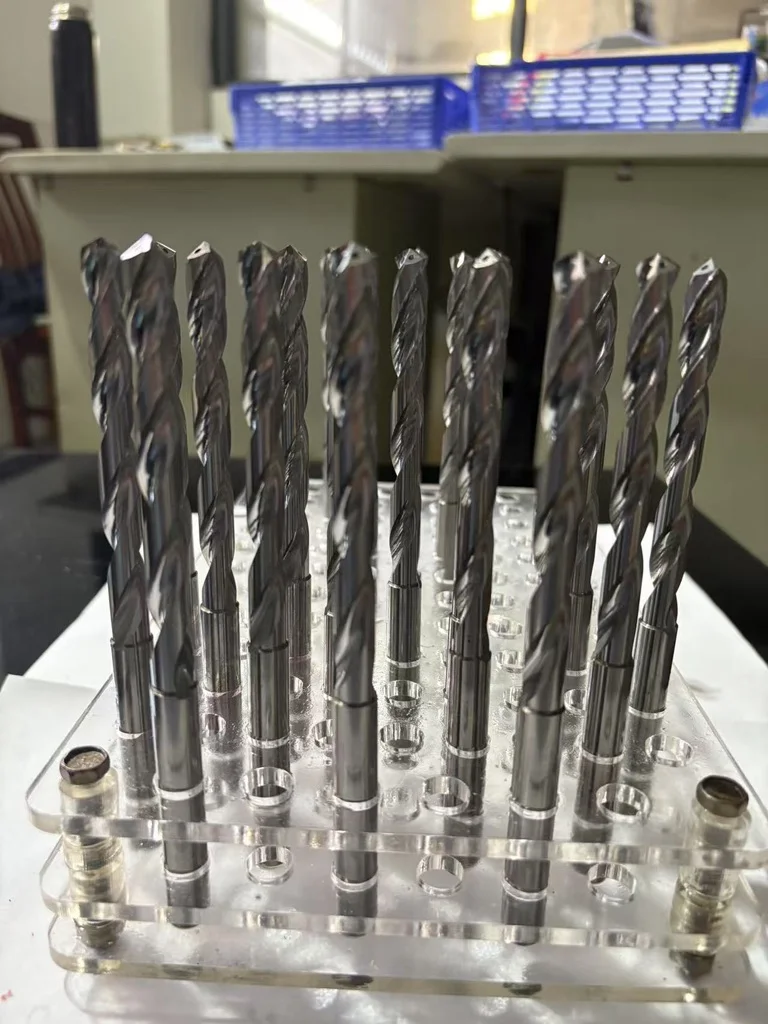
DIN 333 addresses centre drills for 60° centre-hole geometries and distinguishes forms R, A and B. It does not describe the same function as a conventional twist drill making a production bore. Start by identifying the centre-hole form on the component drawing. This guide explains the size fields to confirm, common ordering mistakes and how to approach a supplier with a complete requirement.
What does DIN 333 cover?
The small pilot diameter and the larger body diameter are separate dimensions. A request for a “3 mm centre drill” is incomplete unless the meaning of 3 mm and the required form are clear. The centre-hole requirement should be related to the component drawing rather than inferred from a photograph.
The reference used here is DIN 333:1986-04. Read the primary standard or manufacturer reference for the exact scope. For a purchase requiring formal conformance, identify the agreed edition and obtain the applicable standard and item drawing; the checklist below does not reproduce its complete dimensional tables.
Which sizes belong on the RFQ?
There is no single universal “DIN 333 drill size.” A standard identifies a defined family or feature, while the order still needs a selected diameter and the relevant geometry. Record each size using the symbols on the supplier’s drawing, because symbol conventions can differ between catalogs. Use millimetres for dimensional fields and state any angular requirement separately.
| Size or specification field | What to confirm |
|---|---|
| Centre-hole form | R, A or B as required by the component drawing |
| Pilot diameter | Small cutting diameter, in mm |
| Body diameter | Larger tool diameter, in mm |
| Pilot and cone geometry | Use the selected form’s drawing |
| Overall length and material | Tool length, tool material and any coating requirement |
If a catalog provides several rows for one diameter, preserve the full item code and any form or length suffix. Do not select a nearby row solely because the diameter matches. A tool’s nominal size, manufacturing tolerance and the component’s finished-hole tolerance are different pieces of information.
A practical selection mistake to avoid
A workshop may use the phrase “centre drill” when it actually wants a short spotting operation before a carbide drill. Those are different requirements. Explain whether the feature is a functional centre hole for subsequent support or an entry preparation for another drill. A supplier can then review the appropriate geometry instead of quoting from an ambiguous name.
Who can supply DIN 333 tooling?
TOTEM’s manufacturer catalog includes centre drills; Gühring’s catalogs also provide a route to centre-hole tooling. Confirm the material and selected form on the offered item.
Use the linked catalog as a starting point, then request the exact item drawing, construction, size row and standard edition from the seller. A manufacturer’s broad tool portfolio is not evidence that every diameter or form is stocked, or that a custom proposal automatically conforms to DIN 333.
Discuss a carbide alternative with KYTOOLS
KYTOOLS (Changzhou Kong Yun Precision Tools Co., Ltd.) publishes solid-carbide drill families and drawing-based tooling. If you are considering a carbide alternative or a special geometry, send the original standard requirement together with the part drawing and existing tool dimensions. Ask KYTOOLS to review the proposed construction and dimensional match before approval.
The published KYTOOLS catalog is the source for its listed models; this article does not declare those models compliant with every DIN number discussed. Keep any requirement for DIN 333 conformance, including form, edition and inspection documentation, explicit in the inquiry.
A useful quotation and approval checklist
- Attach the component drawing and, if available, the existing tool drawing or printed catalog code.
- State the workpiece material, hole condition and required dimensions with units and tolerances.
- Identify the machine, holder or taper connection and the coolant arrangement.
- Name the required standard edition and any permitted deviations; request written confirmation on the proposed drawing.
- Agree quantity, measurement method, marking, quotation validity and delivery destination.
When comparing a conventional standard tool and a drawing-based carbide alternative, qualify the proposed process as well as the purchase description. Keep the approved drawing and inspection record with the item code so a later reorder refers to the same configuration.
Send your drill specification to KYTOOLS, or download the drill catalog and inquiry template.